Free ADHD symptom tracker
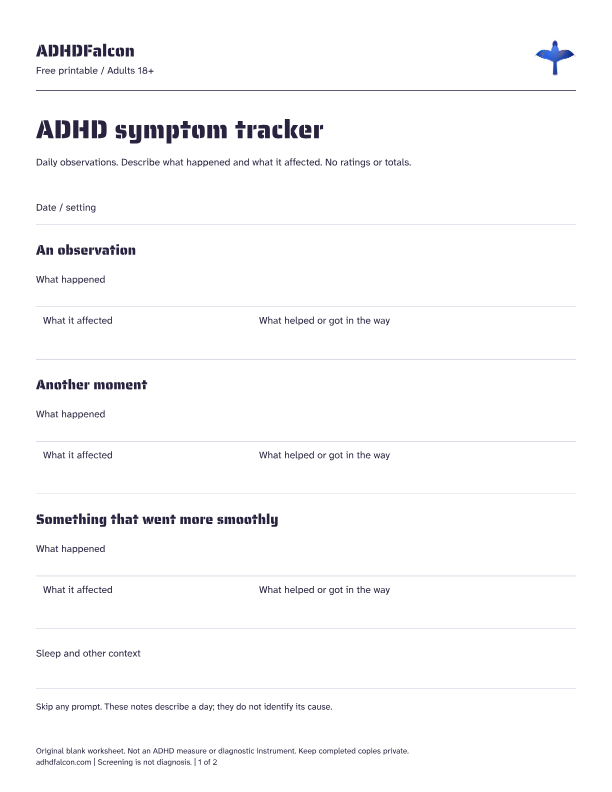
Download a free ADHD symptom tracker PDF with a daily observation sheet and a weekly review. Write down situations, their impact and what helped, then bring the patterns to a clinician. For adults 18+. This blank journal does not screen for or diagnose ADHD.
Download free PDF2 pages · US Letter · Undated · No email needed
One day in detail. One week in view.
- Daily page: three observation spaces with room for context.
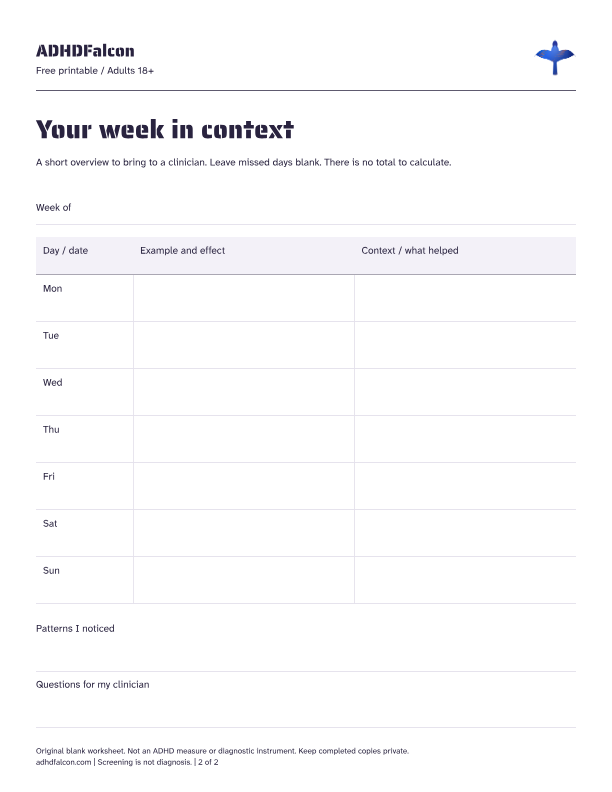
- Weekly page: seven dated rows and a place to notice patterns.
- Appointment notes: questions to bring, without a score or checklist.
Print a page. Keep your notes private.
Print at actual size on US Letter, or choose Fit for A4. This is a blank, print-ready PDF. Write on paper or annotate it in your own PDF app. Completed notes stay with you.
How to use the daily symptom tracker
Print the daily page when you want space for an example. Start with the date and setting. Describe an event you could have observed, such as leaving a bill unfinished when a call came in. Add the practical effect, such as paying it late. Note what made the task easier as well as harder. You do not need to fill every space or wait for a difficult day.
Scroll horizontally to read every column.
| Prompt | Example note |
|---|---|
| What happened | I opened the bill, took a call and left the envelope on the desk. |
| What it affected | I noticed it again after the due date. |
| What helped or got in the way | Putting the bill by my calendar helped me return to it. |
| Sleep and other context | I had slept less than usual; the call was unexpected. |
Use the weekly page to keep the context
The second page gives each day one row. Write a short example, its effect and the surrounding circumstances. A quiet day is useful context too. At the end of the week, look for situations that recur and supports worth keeping. Leave missed days blank rather than reconstructing details you cannot remember. There is no required tracking period and no total to calculate.
What to bring to an appointment
Choose a few examples that show what you want help with. Include where it happens, how long you remember it happening and what you already do to manage it. Keep a separate medication list if your clinician requests one. The journal cannot tell whether a change is caused by a medication, sleep, stress, ADHD or something else. Ask your clinician about treatment questions rather than changing treatment based on these notes.
A journal and a screener answer different questions
This tracker is an original blank journal. It has no published symptom items, ratings, cutoff or diagnostic interpretation. It can help you describe daily life, but it cannot replace the history and evaluation a clinician needs. The adult screening guide explains the separate six-question ASRS v1.1: free to take, with full results and the report for a one-time $7.95.
The appointment questions guide can help you decide what to ask about the examples you bring.
Want a page for planning tomorrow instead? The ADHD daily planner has top three tasks, time blocks and transition notes. The symptom timeline worksheet leaves room for earlier life and approximate dates.
Frequently asked questions
Is the ADHD symptom tracker free?
Yes. Both blank PDF pages are free to download without an email or account. The separate online screener is free to take; its full result and report cost $7.95 once.
How long should I track symptoms?
There is no required period for this journal. Use the daily page when an example is useful and the weekly page when you want a short overview. Ask your clinician if they want notes over a particular period. Do not delay asking for help to finish the tracker.
Does this tracker give an ADHD score?
No. It has no rating scale, symptom count or screening outcome. It organizes your observations for a conversation and cannot diagnose ADHD or show whether treatment is working.
Where are completed tracker notes stored?
The download is a blank file. There is no online entry form and no upload. Keep completed paper or digital copies private and share them only with people you choose.
Sources and scope
The worksheet design and examples are original editorial planning suggestions. The sources below explain adult evaluation and the limits of self-observation. They do not validate this worksheet as an assessment or treatment.
Prepared by the ADHDFalcon editorial team. Published and source check 2026-11-20. No medical review has occurred.